Preventive fleet maintenance by mileage, engine hours or date.
Service intervals that actually come due, work orders that cannot be signed off
twice, and a component history for every vehicle — so a maintenance record is a defensible
document rather than a folder of receipts.
For a fleet operator the unit of work is the vehicle, not the consignment. A missed service
interval becomes a breakdown; an unclear service history becomes an argument with an
insurer, a lessor or a buyer. Spreadsheets and calendar reminders track dates well and
usage badly — and usage is what wears a vehicle out.
CapabilityMaintenance
Service schedules on usage counters, not just the calendar
Each asset carries its usage counters — odometer kilometres, engine hours or cycles — and a
maintenance task can come due on a counter interval as well as on time. A schedule counts
down from the reading at which it starts and restarts from the reading recorded when the
service is done, so "every 15,000 km" means fifteen thousand kilometres from the last
service, not from the day the vehicle was entered.
Each asset shows what is due, what is not yet due and what has no schedule at all — three
different answers that a single "OK" hides.
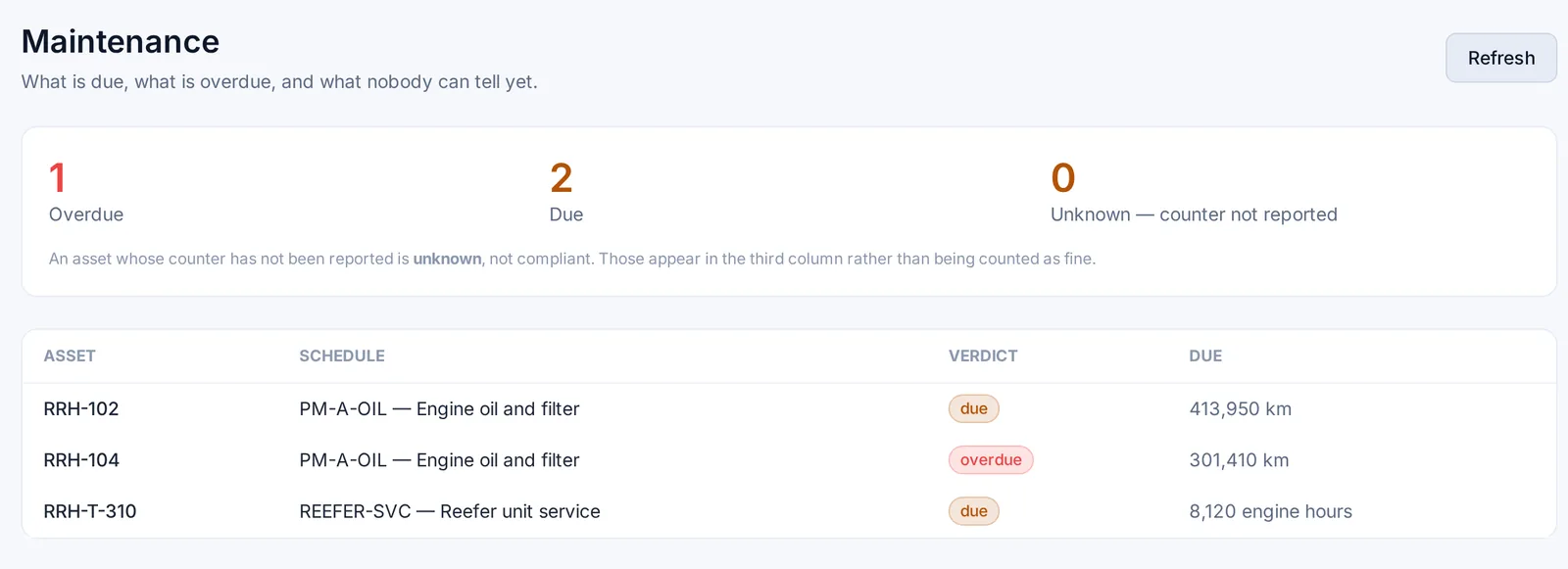
What is due across the fleet, by kilometres, engine hours or date — and a separate count for assets whose reading has not been reported.Demo tenant — the companies and data shown are fictional.
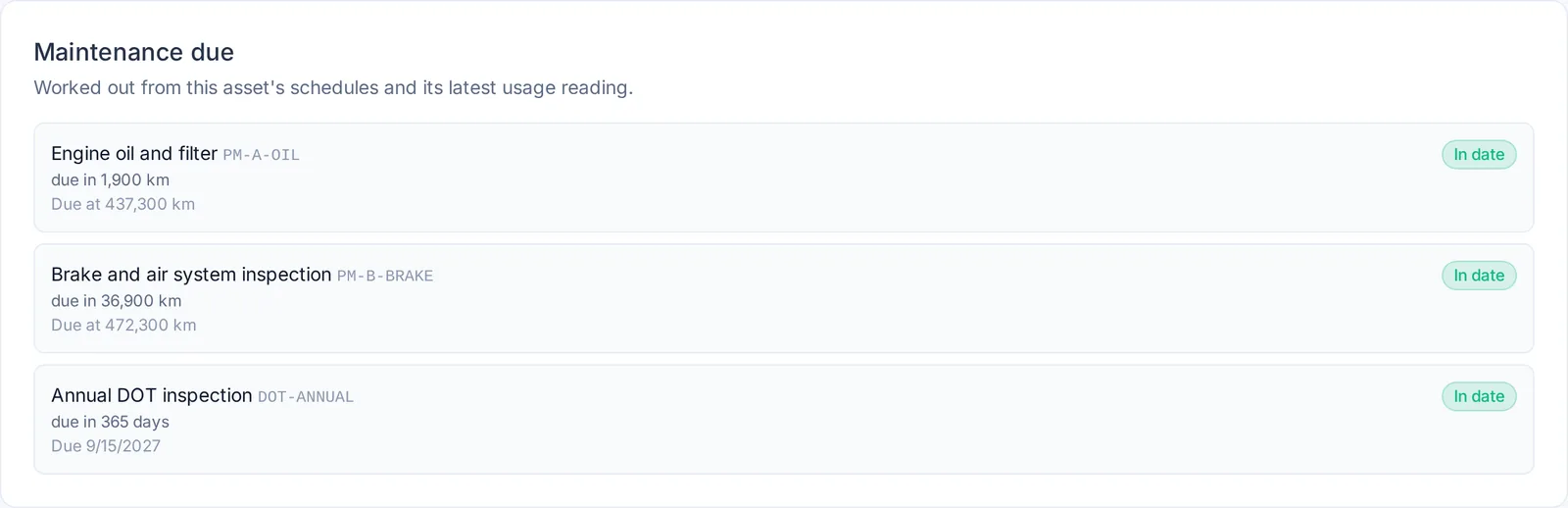
One truck, each schedule worked out from its own interval and the latest odometer reading.Demo tenant — the companies and data shown are fictional.
CapabilityMaintenance
Work orders and component history
Work orders are raised against an asset and a task and completed with the reading at which
the work was done. A completed work order cannot be reopened and signed off again. Parts are
recorded as installed on a vehicle and later removed, so every asset carries its own
component history, and changing a schedule never erases when a task was last done.
Replaces
Service spreadsheets, calendar reminders and receipt folders
Produces
A per-vehicle maintenance and component record
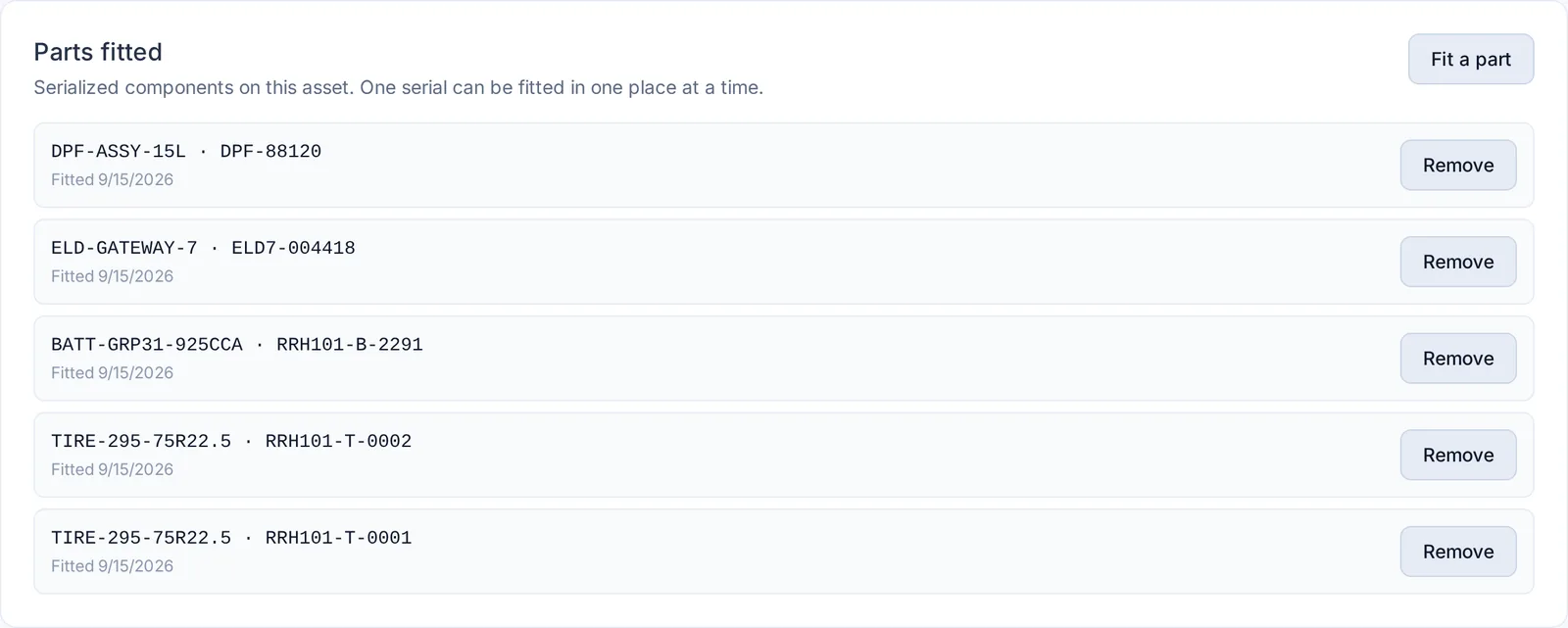
What is fitted to this truck, by part number and serial. One serial can only be fitted in one place at a time.Demo tenant — the companies and data shown are fictional.
CapabilityIncluded
Vehicle tracking alongside the maintenance record
Vehicle positions arrive from telematics such as Motive or from your own GPS trackers,
each stored with the age of its fix. Fleets that also move freight get shipment tracking,
custody and alerts from the same platform — see shipment
visibility.
Questions
Fleet maintenance FAQ
Can maintenance be scheduled by mileage or engine hours?
Yes — odometer kilometres, engine hours or cycles, as well as time. The interval counts
from the reading at the last service.
Is the service history kept when a schedule changes?
Yes. Changing or re-applying a schedule keeps when each task was last completed, and a
completed work order cannot be reopened.
Can we record which parts are fitted to each vehicle?
Yes. Parts are installed on and removed from an asset, giving each vehicle its own
component history.
Can we import our fleet list and service records?
Assets, maintenance tasks, usage readings and work orders import from a spreadsheet or
ERP export, previewed row by row. See moving your data.
Is it an aviation airworthiness record?
No. Cargovate keeps an operator's maintenance history; it is not a regulatory
airworthiness or certification record and should not be used as one.
Put ten of your vehicles in it.
We will load a sample of your fleet and service history and show you what is actually due.