Eleven capabilities. You license the ones you use.
Five are included from the first day. The remaining six are switched on when a
need is demonstrated, not bundled in to inflate a contract. Every capability is a boundary the
platform actually enforces — not a marketing grouping.
Capability 01Included
Core
Shipments, legs and checkpoints. A consignment is modelled as a journey made of movements
rather than a single "current location" field that gets overwritten each time something
changes — so the history of how goods travelled survives, instead of being replaced by
where they ended up.
Includes
Shipments and itineraries · checkpoints from a phone, a device or
your own system · purchase orders · the party registry · documents · alerts ·
an append-only audit trail the application itself cannot edit
Connects to
Spreadsheet and ERP-export import · REST API · QR scanning
from any phone
Replaces
Status spreadsheets and per-carrier portal lookups
Produces
An ordered, queryable movement history per consignment
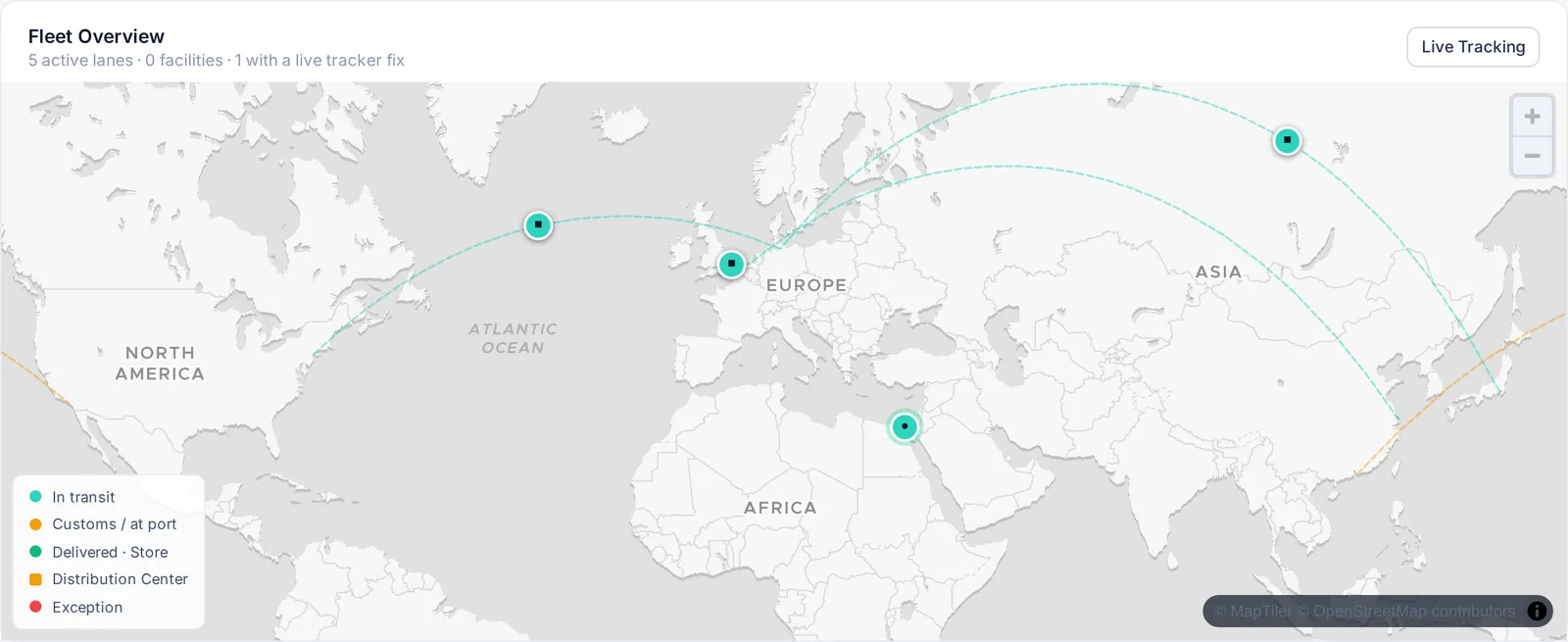
Every active lane. A position from a real tracker is drawn solid and ringed; the rest are estimated from shipment status, and the map says which is which.Demo tenant — the companies and data shown are fictional.
Capability 02Included
Custody
Who physically held the goods, when responsibility transferred, and on whose authority.
Custody is recorded as a chain of handovers, so a gap is visible as a gap rather than
quietly interpolated.
A client's custody record belongs to that client from the first row written and leaves
with them intact if they move to another provider. That is a deliberate design decision,
not a policy statement.
Replaces
Signed paper PODs and email confirmation threads
Produces
An attributable handover record per leg
Capability 03Included
Compliance
Documentation held against the movement it belongs to, retrievable long after the
shipment closed and the person who filed it has moved on. The common failure is not
missing paperwork but paperwork nobody can locate under time pressure.
Replaces
Shared drives organised by whoever filed last
Produces
Evidence attached to the consignment it concerns
Capability 04Included
Import
Ingest from the systems you already run, rather than requiring you to abandon them.
Imports are idempotent: running the same file twice does not duplicate history, which
matters because in practice the same file will be run twice.
Replaces
Manual re-keying between carrier exports and internal systems
Produces
One canonical record from many source formats
Capability 05Included
Tracking
Where things actually are, rather than where the schedule says they should be. Positions
arrive from your own devices or from the telematics system you already run, and each one
carries the age of its fix — because a position with no timestamp invites a decision based
on where a vehicle was four hours ago.
Includes
Live positions on the map, with stale fixes marked as such ·
temperature, humidity, shock and battery readings held against the shipment ·
your own devices, authenticated individually
Connects to
Motive vehicle-location webhooks · flight and air-waybill
tracking providers · any device that can POST, over a documented ingest
For
Fleets, and anyone whose goods carry a tracker
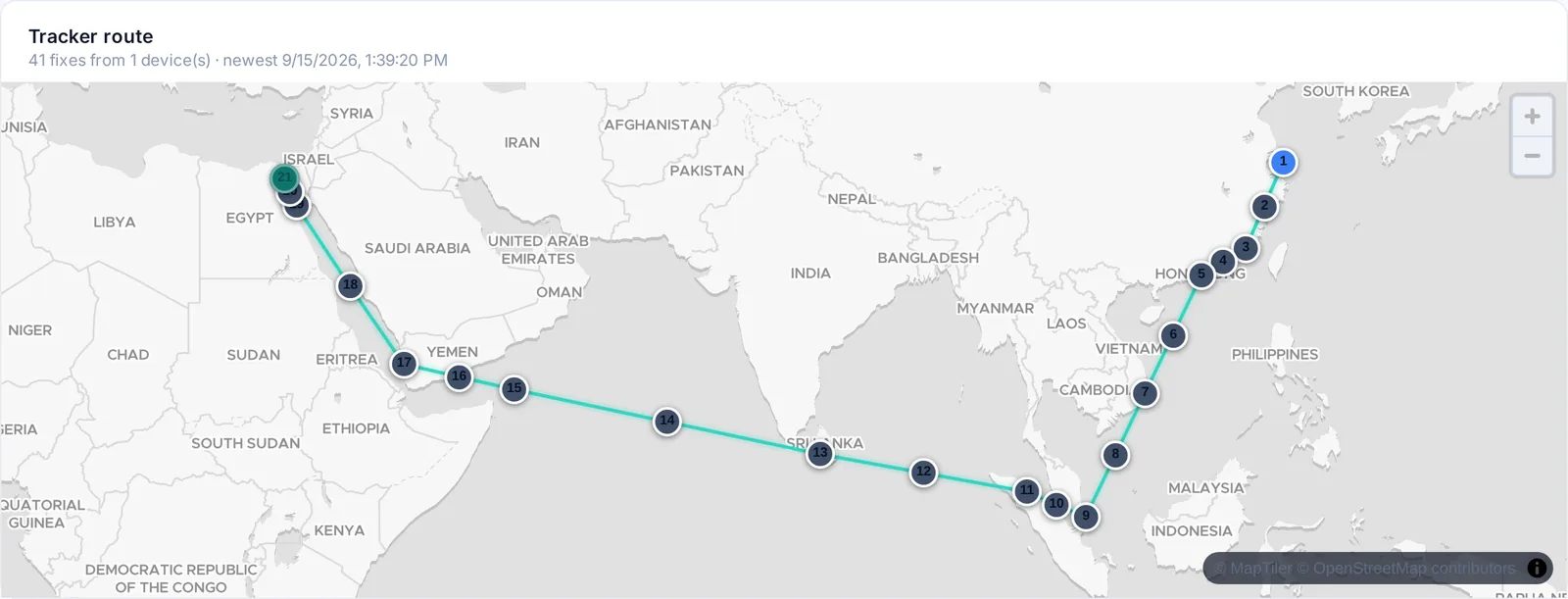
Twenty days of a reefer logger’s positions, Shanghai to Suez. Each fix is stored with the time it was taken and its accuracy.
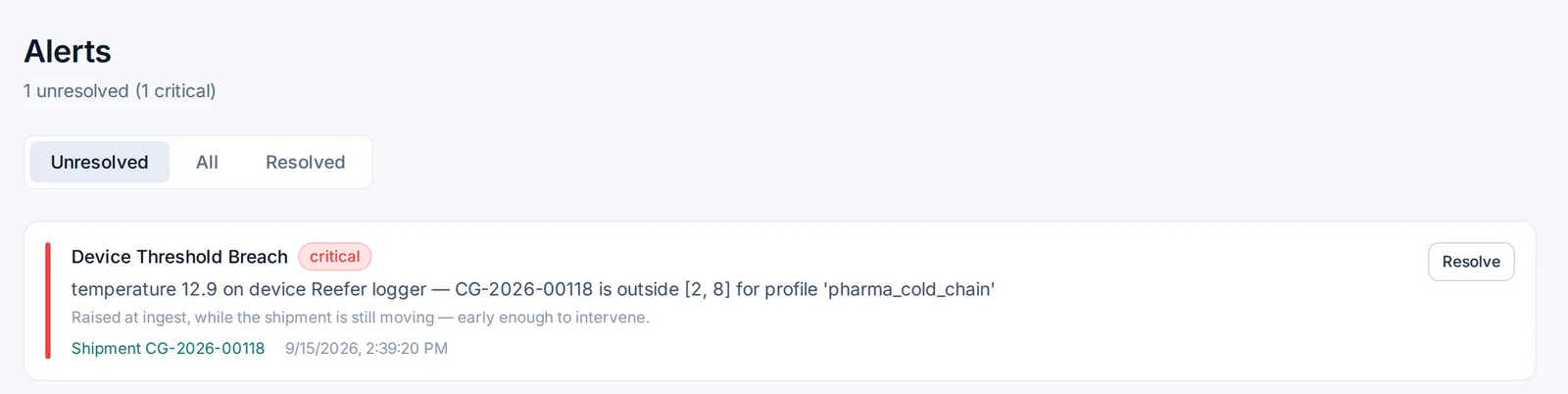
A cold-chain excursion caught mid-voyage. The reading is checked against the device’s condition profile as it arrives, and the alert is raised on the shipment.Demo tenant — the companies and data shown are fictional.
Capability 06Optional
Warehouse
Stock held at a location, on a pallet, in a lot — with what is promised to somebody
else tracked apart from what is free to sell. Relevant when inventory sits still long
enough that where it sits, and whether it is already spoken for, become questions worth
answering.
Includes
Distribution centres and stores · locations down to the bin ·
handling units, so a pallet moves with its contents · lot, expiry, condition and
serial tracking · units of measure, receiving in cases and picking in eaches ·
reservations, separating on hand from promised from available · transfers between
your own sites, with what is still in transit visible at both ends
Connects to
Handheld scanners over a per-facility key · stock, items and
locations imported from a spreadsheet or an ERP export
Cost baselines and measured operational savings against them. A baseline is only useful
if it is honest about its own inputs, so declared figures are kept visibly distinct from
measured ones.
For
Operators building a cost case, internally or to a client
Capability 08Optional
Maintenance
Asset and fleet lifecycle — service intervals, due dates and history per vehicle or unit.
A separate discipline from moving consignments, and sold as one rather than assumed.
For
Fleet operators; any business where downtime is the dominant cost
Capability 09Optional
Manufacturing
The production record — what was made, from which materials, by whom, on which
equipment, and what evidence exists that it was done correctly. Parts, routings, units,
build steps and genealogy: the history a serial number carries before it ever becomes
freight.
Release is a gate, not a status field. A unit cannot be released while an operation is
incomplete, required evidence is missing, a nonconformance is open, or a contract
flow-down is unresolved. There is no override parameter, because a gate with an override
is a status field with extra steps.
An operation refuses to complete if the person performing it does not hold the required
certification, or if a named tool is out of calibration. A tool with no calibration
record blocks exactly as firmly as an expired one — never calibrated is not the same as
fine.
Your own customers get a narrow surface of their own: submit an order, track its
progress, and see nothing else. Not units, not serials, not build steps, not other
customers' orders, and not that any of them exist.
For
Manufacturers who must prove how something was built, not only that it shipped
Answers
"Who built this serial, to which revision, from what material, and what evidence stands behind it"
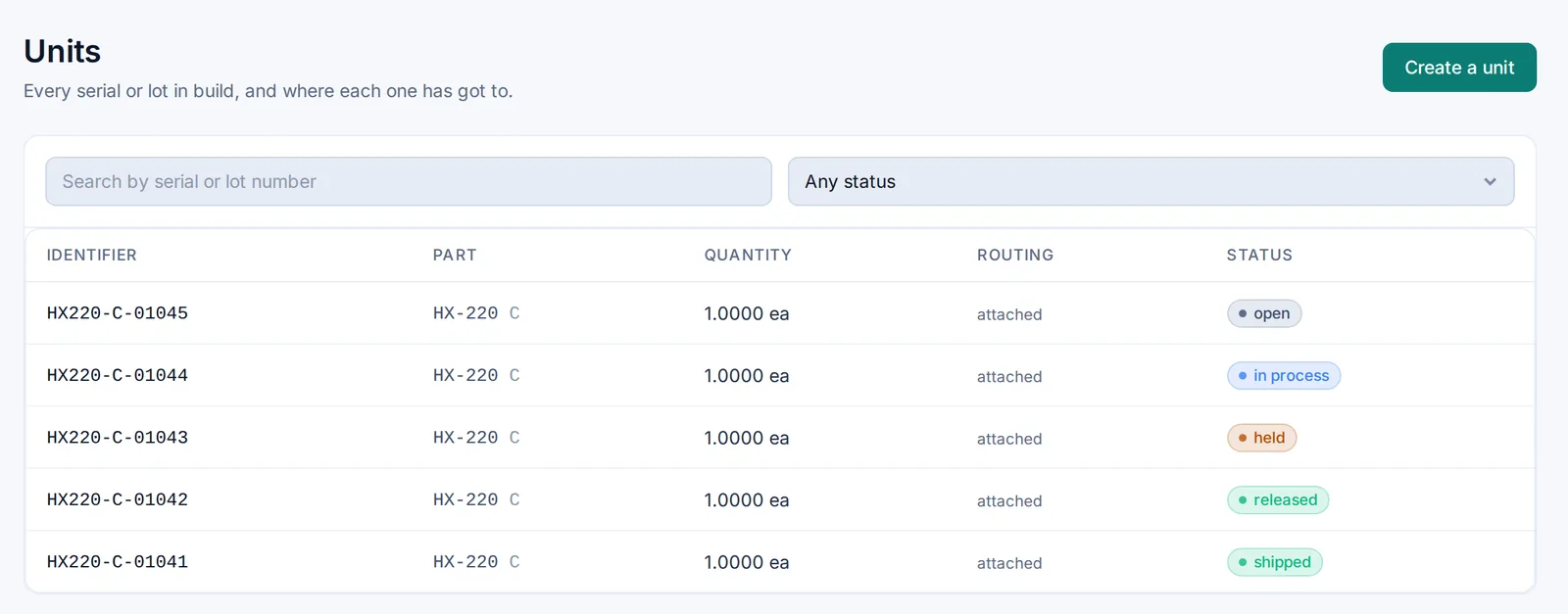
Every serial and where it has got to — open, in process, held by a nonconformance, released, shipped.
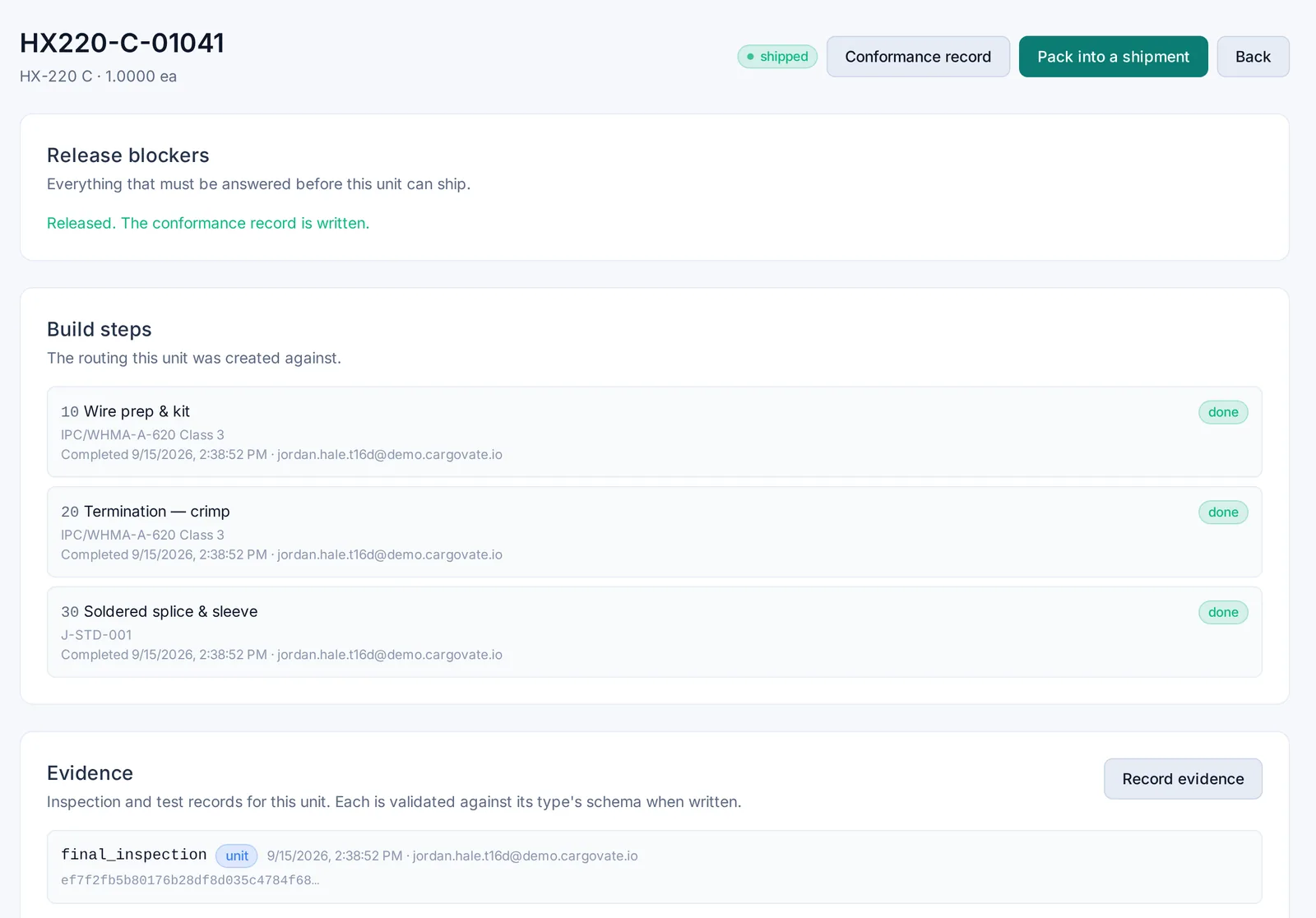
A released unit’s record. Each operation with the standard it was built to and who completed it, and inspection evidence carrying a content hash.Demo tenant — the companies and data shown are fictional.
Capability 10Optional
Agency
Act on behalf of client organisations without merging their data. A third-party logistics
provider needs a view across the clients it serves; each of those clients must never see
another's consignments, and must not be able to infer them from an aggregate either.
Cross-client reporting therefore stays with the agent and is never surfaced back to an
individual principal — because with a small number of clients, a principal could subtract
its own figures and recover a competitor's.
For
Freight forwarders and 3PLs acting for named clients
Capability 11Optional
Anchoring
Commit a tamper-evident fingerprint of the custody record to an independent ledger. This
matters in exactly one situation: when a record has to be provable to someone who has no
reason to trust you — an insurer, a regulator, a counterparty in dispute.
It is off by default and priced separately, because most operators do not need it and
should not pay for it. The platform is fully functional without it.
For
High-value, contested or regulated consignments
Answers
"Prove this record has not been edited since it was written"
Which of these do you actually need?
Usually fewer than expected. A short session against your own operation will
establish it faster than a pricing page.